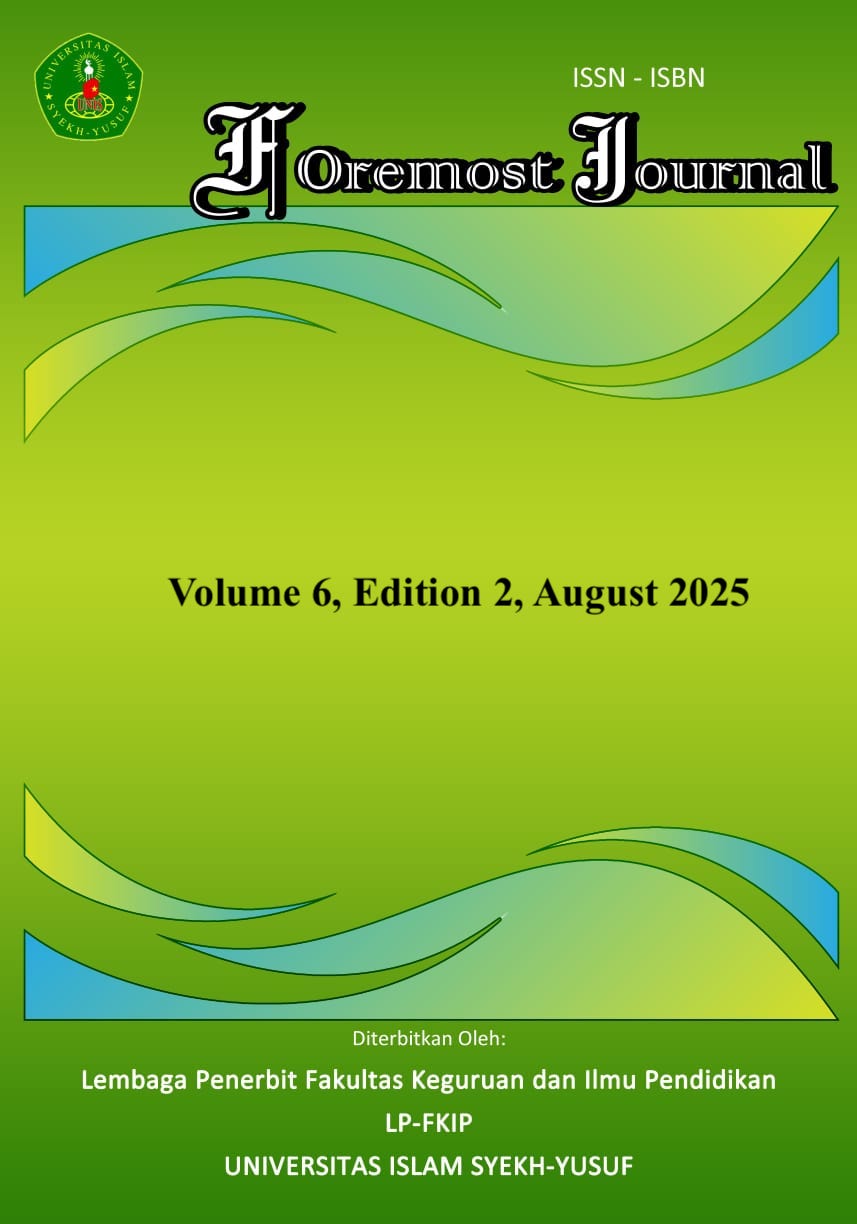
The Effect of the Story Map Method in Narrative Text to Improve Students' Reading Skills
DOI:
https://doi.org/10.33592/foremost.v6i2.7727Keywords:
Quasi-Experimental, Reading Skill, Story Map MethodAbstract
Investigation on instructional strategies provides valuable insights that contributes to students’ better academic outcomes. This study aims to determine the significant effect of using the story map method on improving the reading skills of eleventh-grade science students at Madrasah Aliyah Attaqwa Tangerang. The research specifically focuses on their comprehension of narrative text learning material during the 2023/2024 academic year. This study employed a Quasi-Experimental Design. The research population consisted of all eleventh-grade science (XI IPA) students at Madrasah Aliyah Attaqwa Tangerang for the 2023/2024 academic year. The sample size was 30 students. Data were collected through pre-test and post-test instruments to measure student reading skills before and after the intervention. The collected data were tested for assumptions and found to be both normally distributed and homogeneous. Subsequently, hypothesis testing was conducted using a paired sample t-test. The results of the hypothesis test led to the rejection of the null hypothesis (Ho) and the acceptance of the alternative hypothesis (Ha). This indicates a statistically significant positive effect from using the story map method. Therefore, it is concluded that the story map method effectively improves the reading skills of eleventh-grade science students at Madrasah Aliyah Attaqwa Tangerang in narrative text comprehension.
Downloads
Published
How to Cite
Issue
Section
License
Copyright (c) 2025 Foremost Journal

This work is licensed under a Creative Commons Attribution-NonCommercial-ShareAlike 4.0 International License.
- Authors certify that the work reported here has not been published before and contains no materials the publication of which would violate any copyright or other personal or proprietary right of any person or entity.
- Authors transfer or license the copyright of publishing to Foremost Journal to publish the article in any media format, to share, to disseminate, to index, and to maximize the impact of the article in any databases.
- Authors hereby agree to transfer a copyright for publishing to Foremost Journal a Publisher of the manuscript.
- Authors reserve the following:
- all proprietary rights other than copyright such as patent rights;
- the right to use all or part of this article in future works of our own such as in books and lectures;
- use for presentation in a meeting or conference and distributing copies to attendees;
- use for internal training by author's company;
- distribution to colleagues for their research use;
- use in a subsequent compilation of the author's works;
- inclusion in a thesis or dissertation;
- reuse of portions or extracts from the article in other works (with full acknowledgement of final article);
- preparation of derivative works (other than commercial purposes) (with full acknowledgement of final article); and
- voluntary posting on open web sites operated by author or author’s institution for scholarly purposes, but it should follow the open access license of Creative Common CC BY-NC-SA License.